They didn´t have Scanners etc in those days so they relied on physical methods, like in this case poking about with the tip of a halbard.
The set (15 pieces in metal) is called "Vor dem Stadttor" (In front of the town gate) and is available from Fredericus Rex
Close ups
Guards
Mr wood cutter, wife and son
Dobin and cart
The axle Pins are bit thin, the hole in the wheels an bit large. I´m no fan of glueing unless there´s no other solution so I came up with this.
Short bit of wire insulation on the axle, the holes in the wheels filed a tiny bit larger and Bingo.
These (the first Batch) will end up as part of the Teutonic order 1329 dio
After a bit of research on the sort of Sheets, blankets etc that would be on medieval beds I found contemporay pics showing beds with either very expensive richly coloured or cheap plain bedcovering. but a lot, rich or poor had either off White or pure white Sheets and pillows.
Seeing as These are "middle class beds, I went for the off White Sheets and pillows and to add a bit of colour variety made the covers (or Cloaks ) a different colour.
The Gaol will be part of the main town, the Farmhouse part of the (nearly completed) Village.
I decided to have to ground floor where the prisoners are held as a stonework construction , the cells being accessed from the upper floor.
The final Building for the Village is being constructed and then the basing can commence
A Sad note.
In August this year, Hobby Enthusiast and, I must say, A really nice Guy, Sven Schmelzer died leaving behind a wife and daughter.
To help Support His family, his Collection of dioramas and Models are being sold and can be seen on the following links; PART ONE PART TWO
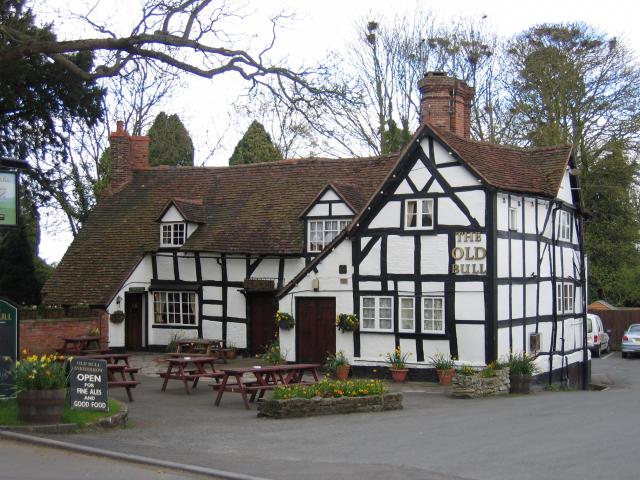
Well..it doesn´t exist....Not the one run by Kenton and Jolene Archer* but The Old Bull, in Inkberrow, Worcestershire, (on which the fictional Bull is based ) does.
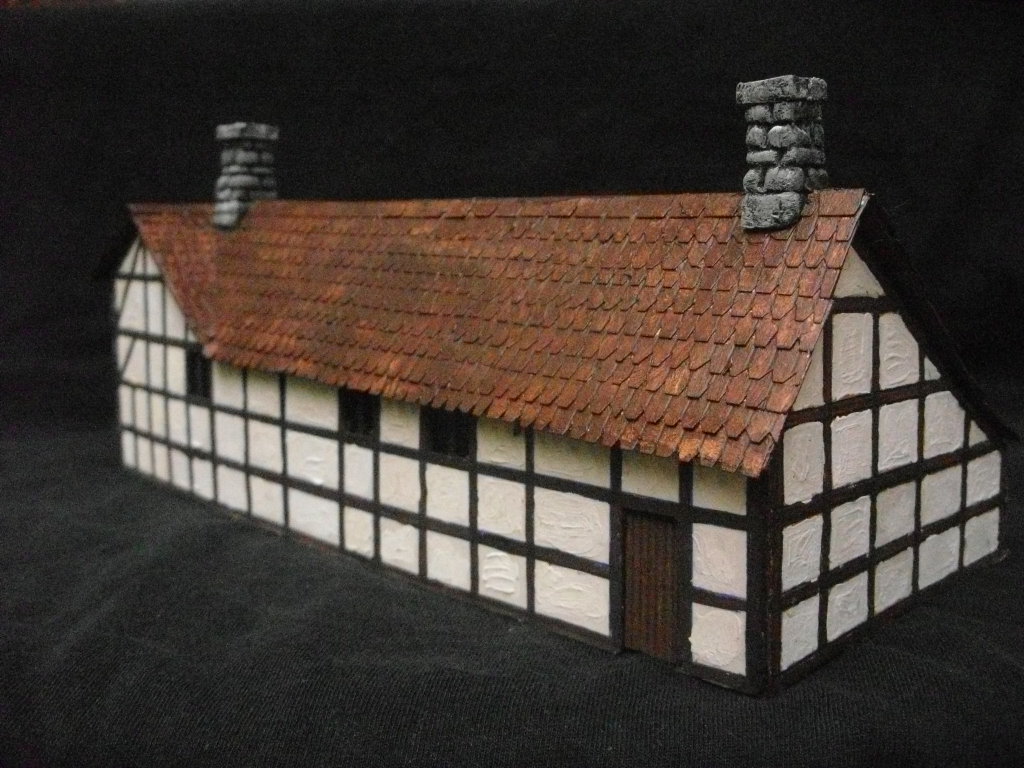
No White framed Windows, the rear and right Hand side walls are made up ( you´d think there would be some side and rear view pictures but I couldn´t find any) and removed the hatch to the beer cellar (in some pics it´s there..others it´s not. )
So..strap some bells around your ankles, gather around the maypole, hankies Held in the air... ---2..3..4... "Dumm - de -dumm-de dumm de dumm, dumm -de dum, de da da"
* For those who don´t know, Kenton and Jolene Archer, are characters in a Radio series called the Archers which is set in the fictional village of Ambridge in the fictional county of Borsetshire (the Dumm - de -dumm...etc)
There´s detailed maps etc of how the fictional world of the Archers is laid out, biographies, Family historys, the whole lot..even down to including a fictional ECW Battle, the Skirmish at Ambridge September 1642
After seeing Tony´s excellent scratchbuilt Windmill (HERE) I realised that "Card town" is missing one..so...
"In Progress" pics.
Cardboard, toothpicks and a stick from firework rockets for the base construction.(The Trestle)
The sails had always put me off making a windmill, getting them all the same size being the main concern, but after a bit of thought a solution is found.
The small block will be the "poll end" (the hub holding the sail arms ) Why are they slightly traingular when virtually all windmill sails are rectangular? I simply liked the look. The Piece at the top is the "Tailpole" used for moving the the mill to face into the wind ( called winding or luffing )
In Roman times a harvester, called the Gallic Vallus, was developed
Described by the historian Pliny the Elder in 77 AD. According to Pliny, "on the vast estates in the provinces of Gaul very large frames fitted with teeth at the edge and carried on two wheels are driven through the corn by a donkey pushing from behind; the ears torn off fall into the frame."
There is another Version with an Ox pushing a similar looking device, and both types appear to have had either teeth or long prongs at the front to rip the corn heads off.
The conductor should be at the back of the frame and acts as a counterweight and to guide the harvester to the right, to the left, up, down. A conpulsor works at the front, pressing the ears of corn forward until they get stuck and ripped off in the teeth of the "comb".
A relief from Trier showing a gallic harvester. . How effective was it compared to a scythe? Tests with reconstructions Show that they do actually work and can clear a field faster than with scythes with as much or as little wastage.
I´ve never put up any pics of the buildings as one town, and seeing as the Project won´t be going any further..here´s are all the buildings grouped together.
Anyway..as the Project is closed and it seems a shame to just store it in the cellar, the whole lot is up for sale. Price? I´ve got something in mind* but I prefer to be open to "suggestions" so if your interested, tell me what you think it´s worth.
*For the whole town, I could re-make individual buildings if anyone´s interested but I would like this lot to stay together.
With accompanying kniggits.
The overfed Monk on the mule is from Strelets, Crusader Transport 1 set. The Monk with the staff is a conversion from the same set and Adolphus, (reading ) a conversion from the Strelets Norman Train set.
With a new house, a Hay barrack and some other bits and pieces (all scratchbuilt) added.
First off, all grouped together as a small farming community.
Now as individual Farmsteads (as originally planned) House with vegetable / Herb garden
Cabbages made with green crepe paper The "Woodcutters" house
Barn with Hay Barrack and Wagon
The "Bakers" House with bread oven
Buildings - Card with clay roofs
Fences/ladders/surrounds for the raised beds - Coffee stirrers and lolly sticks
The Cabbages - green crepe paper
Bean Poles and Logs - Bits of birch twig
Wagon - Thin Card and strips of Wood.
Hay - Plumbers thread
Moss - Bits of rubber foam (that was left outside in the rain etc to go green)
Bakers oven - Clay
Forgot...the buildings with their respective "Stedders" can be seen HERE
Along with Bodston - Main town (the 50 buildings Project) Boddingham - the farming community centre (10 buildings) and Boddington- the Fishing and farming Hamlet (6 buildings with a stockade) I´ve decided to create a couple of small farmsteads based on the ones at the Plimoth plantation..
Ok...they are buildings from the early 17th Cent and Bodstonia is 18th century based but it´s an Imagi-Nation so they fit.
Farmhouses. The Window shutters are in a sort of Frame and can be slid shut.
I tried to recreate the Clapboard planking using short pieces of Card as on the real buildings, but it ended up looking complete mess so the I used continous strips instead.
Rear with storage shed.
The woodclad chimneys. Wood cladding with a surrounding thatch..slight fire hazard? This got me wondering.. so after a bit of looking around I found a pic of one of the Plimoth houses showing the inside of the chimney (from the hearth up to the top) and it Shows the insides are coated with something that Looks like clay.
Goat shed and "community barn"
This film, a psychological Horror called ,The VVitch (the Witch) which is filmed partly in the Plimoth Foundation.(the main street can be seen in the opening Scene)
Reckoned to be as historically accurate as a film can be.... and well scarey :-D There´s evil in the Wood!!!!
Another generic building with an Experiment in creating a covered walkway.
The total so far...Picture taken before the above building had the tiles added, I wanted to see where it might fit into the General layout.
31 buildings so far.
I haven´t counted the Pigeon Loft as it may or may not be added and for a 18th Cent Bodstonian setting there´s the Fire station.
Only another 19 to go, (17 if the pigeon loft and fire Station are taken into consideration) like a couple more additions to the "industrial area" (top right) but as I´ve said previously, the layout is temporary.
A Cathedral is being considered as a possible Addition which would Change the layout considerably as it would more than likely take up a central Position, pushing the "industrial" area (just above the church/Meeting house) out to the side.
Super Blood Moon eclipse tonight! Link I´m going to try and stay up and take pics..anyone else?
A structure with a movable roof for storing loose hay.
Easy to build, ram 4 Posts into the ground and attach a thatch or shingle Roof that can be moved up and down. Low maintenance, the Posts could last up to 40 years, the thatch would Need changing occasionally.
Widespread in northern Europe in medieval times but not so common These days.
Thought to have originated in Holland, The oldest written source is from 1022.
Although they are not common These days, they are coming back, especially in Holland where they are called Hooiberg (Hay mountains) and a society (the Hooiberg Museum) is promoting thier use.
Like all things that look simple..they aren´t. It´s not just a case of bunging loose hay under the Roof and Job done. There´s a lot of specialised knowledge needed to stack and care for the hay as told by the ; Dutch Barn Preservation Society
Hay barrack in the Velislai biblia picta (Velislaus Bible or Velislav's Bible ) 1325–1349.